
Field Guide · Ocean Springs, MS
Walter Anderson Museum of Art (Ocean Springs, MS)
The Walter Anderson Museum of Art (WAMA) on Washington Avenue in Ocean Springs is the most important cultural institution on the Mississippi Gulf Coast. The museum holds the life’s work of a singular American artist, and the centerpiece of the collection, the Community Center Room, is one of the most unusual things you can stand inside in the entire country.
If you are visiting Ocean Springs for the first time and you only do one thing, it should be this.

The essentials. WAMA is open Monday-Saturday 11 a.m. - 5 p.m. and Sunday 1 p.m. - 5 p.m. Admission is $10 for adults; $8 for AAA, military, seniors, and students; $5 for kids 5-15; free under 5. Allow 60-90 minutes self-guided, up to two hours with a docent. The full address is 510 Washington Avenue, Ocean Springs, MS 39564. Photography is allowed in most galleries (no flash); the Community Center Room has its own rules posted at the entrance.
Who Walter Anderson Was
Walter Inglis Anderson was born in 1903 in New Orleans and grew up in Ocean Springs. He studied at the Pennsylvania Academy of Fine Arts and the École des Beaux-Arts in Fontainebleau. He was a skilled draftsman and painter by formal training, but the direction his work took after his return to the Gulf Coast had nothing to do with the academic tradition he came from.
From the 1940s onward, Anderson became obsessively focused on the natural world of the Gulf Coast. He rowed the 14 miles across the Mississippi Sound to Horn Island repeatedly over the last decades of his life, alone, in a small wooden skiff loaded with art supplies. He went in all weather, including conditions that would have made most people stay home. On the island he drew and painted constantly, documenting the birds, plants, fish, insects, and weather with a precision and energy that filled thousands of sheets of paper.

He lived in a small cottage in the backyard of his family’s Shearwater compound and worked in isolation. He was not celebrated during his lifetime. He worked because the work demanded to be made. When he died in 1965, the people who cleared his cottage found thousands of watercolors, drawings, and paintings rolled up, stacked, and covering nearly every surface. He had sealed the walls with his work.

The museum opened in 1991 and has spent the decades since organizing and making sense of the volume of what he left.
The Museum Collection
The main museum building on Washington Avenue houses a rotating selection from the permanent collection, which runs into the thousands of individual works. The watercolors are particularly striking. Anderson’s color is Gulf-specific: the pinks and oranges of sunset over the water, the particular green of cordgrass, the flat light of a cloudy Gulf morning. The shorebird studies are precise without being stiff.


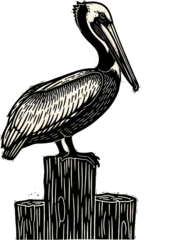
The block prints, done from carved wooden blocks, are a different register from the watercolors. They are bolder and more graphic, closer to folk art in their flatness, but unmistakably the same hand. The museum displays a good selection of these alongside the paintings.
The gift shop sells high-quality reproductions, books about Anderson’s life and work, and original block prints still hand-pulled by Anderson family relatives. It is one of the few museum gift shops where the merchandise carries genuine value beyond a souvenir.
The Community Center Room: The Real Reason to Come
Behind the main museum building, across a courtyard, is the Ocean Springs Community Center, a small building that Anderson was commissioned to decorate for the city in the late 1940s. What he actually did went well beyond a civic mural commission.

Anderson worked on the interior of the Community Center in secret over a period of years. He covered every wall and the ceiling with a single continuous mural depicting a Gulf storm. The composition moves from darkness at the top to sea level along the walls, with waves, birds, fish, and atmospheric effects rendered in his distinctive flat lines and muted blues, greens, and grays. He worked alone, sealed the windows with newspaper to keep people from seeing in, and told no one what he was doing.
The room was not discovered until after his death. His family and the city eventually understood what they had. The space has been preserved largely as he left it.

Standing in the Community Center Room is quiet in a way that is hard to explain before you experience it. The scale is modest but the density of the imagery and the strangeness of knowing it was made in complete secrecy makes it unlike any gallery experience. Allow time to just stand there.
Entry to the Community Center Room is included with your museum admission.
The Little Room (Not What You Think)
A clarification visitors regularly need: the “Little Room” inside the museum is not Anderson’s actual cottage at Shearwater. It is a faithful re-installation of the room, with his original murals and furniture, moved to the museum so the public could see it. The cottage itself at 102 Shearwater Drive is not open to the public and is not part of the museum tour. It is on the private Anderson family compound, viewable only during special events (typically the Peter Anderson Festival).
The Little Room re-creation inside WAMA captures the experience: floor-to-ceiling, four-walls-and-the-ceiling, the world Anderson sealed himself inside while he painted.
Shearwater Pottery and the Anderson Family
The Anderson family has a broader artistic legacy in Ocean Springs than Walter alone. Shearwater Pottery, located nearby at the family compound on Shearwater Drive, was founded by his brother Peter Anderson in 1928 and continues to produce hand-thrown pottery in the Shearwater tradition. The workshop and shop are open year-round (except major holidays) and within a 10-minute drive of the museum.


For anyone interested in the intersection of art, craft, and family history on the Gulf Coast, combining a museum visit with a stop at Shearwater is the right move. The cottage (Walter’s actual studio) is not open to the public, but the pottery shop is, and the work on the shelves is hand-made by Anderson family relatives still operating the studio.
The Traveler Café
WAMA opened The Traveler café on its campus in May 2025, attached to the museum complex. It serves coffee, light breakfast, and lunch alongside merchandise from local artisans. Hours are roughly aligned with the museum (Mon-Sat morning through afternoon; check current hours on the museum site). This means you can now do the full museum visit, lunch on-site, and the Community Center Room in a single uninterrupted block. Useful in summer heat or rain.
Planning Your Visit
Address: 510 Washington Avenue, Ocean Springs, MS 39564.
Hours: Mon-Sat 11 a.m. - 5 p.m.; Sun 1 p.m. - 5 p.m. Closed Easter, Thanksgiving, and Christmas. Hours may shift seasonally. Verify on the museum site before driving.
Admission (2026): Adults $10 / AAA, military, seniors, students $8 / kids 5-15 $5 / under 5 free.
Parking: The main museum lot is small. Accessible parking is at the community center next door, not the main lot. Visitors with mobility needs should head there first. Free street parking is available on Washington Avenue and the adjacent blocks; arrive before 10:30 a.m. on weekends to claim it.

How long to plan: 60-90 minutes is the right minimum for the main building plus Community Center Room. Two hours with a docent. Three hours if you also visit Shearwater Pottery. Half a day if you pair with lunch downtown and the Washington Avenue galleries.
Best time to visit: Weekday mornings are quiet. Saturday afternoons are the busiest. Sundays open later (1 p.m.) and tend to be moderate. The first weekend in November is the Peter Anderson Arts and Crafts Festival: downtown is packed, the museum is at capacity, but it’s the one time of year the Anderson family compound at Shearwater hosts public bike tours.
For the best use of a full day, pair the museum with a walk through downtown Ocean Springs and the Washington Avenue gallery corridor, then spend time at Front Beach in the late afternoon for the sunset view across Biloxi Bay. For a full itinerary built around the town’s best offerings, the perfect weekend in Ocean Springs guide lays it out day by day.

Frequently Asked Questions
What are the Walter Anderson Museum’s hours?
Mon-Sat 11 a.m. - 5 p.m., Sun 1 p.m. - 5 p.m. Closed Easter, Thanksgiving, and Christmas.
How much is admission?
$10 for adults, $8 for AAA, military, seniors, and students, $5 for kids 5-15, free under 5. As of 2026.
How long does it take to see the museum?
60-90 minutes self-guided. Two hours with a docent tour. Add 30-60 minutes for the Community Center Room and the gift shop.
Is the museum kid-friendly?
Yes for ages 6+. Anderson’s subjects (birds, fish, weather, the Gulf) are accessible to children, and the Community Center Room mural reliably gets a reaction. For younger kids, the visit is manageable in 30-40 minutes at a faster pace.
Can I tour Walter Anderson’s actual cottage?
No. The cottage at 102 Shearwater Drive is on the private Anderson family property and is not open to the public. The faithful “Little Room” re-creation inside the museum captures the experience. Shearwater Pottery, the working studio nearby, is open year-round.
Is photography allowed?
In most galleries, yes, without flash. The Community Center Room has its own posted rules. Tripods generally require permission.
Where do I park?
Free street parking on Washington Avenue and adjacent blocks. The main museum lot is small. Accessible parking is at the Ocean Springs Community Center next door, not the main museum lot.
Is there a café on site?
Yes. The Traveler café opened on the WAMA campus in May 2025, serving coffee, breakfast, and lunch.
For more on the cultural corridor and the rest of the gallery district, see the downtown Ocean Springs guide.